
California has strict employment laws governing employee meal and rest breaks. Even businesses with established workplace policies may face legal disputes involving missed, shortened, or interrupted breaks. These claims can result in unpaid wage disputes, financial penalties, class action litigation, and significant legal expenses.
Although California law provides employees with substantial protections, employers may have several legal defenses depending on workplace practices, employment records, and the circumstances surrounding the alleged violations.
Understanding California Meal and Rest Break Laws
California Labor Code Sections 226.7 and 512, along with applicable Industrial Welfare Commission (IWC) Wage Orders, establish employee break requirements.
California Meal Break Requirements
Generally, employers must provide nonexempt employees with:
- An uninterrupted 30-minute meal break when working more than five hours.
- A second 30-minute meal break when working more than ten hours.
California Rest Break Requirements
Employers generally must authorize and permit employees to take:
- A paid 10-minute rest break for every four hours worked or major fraction thereof.
- Rest breaks near the middle of each work period, when acceptable.
- Rest breaks free from work-related responsibilities.
Employees working fewer than three and one-half hours generally are not entitled to a rest break under standard wage orders. Violations of these rules and regulations may expose employers to additional wage obligations under California Labor Code Section 226.7.
What Defenses Do Employers Have Against Meal and Rest Break Lawsuits?
Employers facing California wage-and-hour litigation may have several defenses available. Their applicability depends on the evidence and circumstances of each claim.
1. The Employer Provided Legally Compliant Breaks
An employer may demonstrate that employees received legally compliant opportunities to take meal and rest breaks. However, employers cannot discourage employees from taking breaks or create working conditions that prevent them from doing so. Relevant evidence may include:
- Employee timekeeping records
- Workplace break policies
- Employee handbook acknowledgments
- Staff schedules and coverage arrangements
- Supervisor communications and witness testimony
Written policies should reflect actual workplace practices
2. The Employee Agreed to a Lawful Meal Break Waiver
California Labor Code Section 512 permits meal period waivers under specific circumstances. For example, employees and employers may mutually agree to waive:
- The first meal break when the employee works no more than six hours.
- The second meal break when the employee works no more than twelve hours and has not waived the first meal break.
Employers may rely on valid waiver agreements when defending certain claims. However, a waiver obtained through pressure or applied outside statutory requirements may be unenforceable.
3. The Employer Paid the Required Break Premiums
Under California Labor Code Section 226.7, employers generally must pay an additional hour of compensation at the employee's regular rate when a required meal or rest period is not provided. Employers that properly calculated and paid applicable premiums may dispute allegations of unpaid break compensation.
How Timekeeping Records Affect California Meal Break Lawsuits
Accurate timekeeping records can significantly influence employment litigation. Employers may deny this idea through evidence demonstrating lawful compliance, voluntary employee decisions, or appropriate premium payments. It is also important for businesses to regularly review payroll systems, staffing practices, and break policies to identify potential compliance issues.
Can Employers Defend Against Meal and Rest Break Class Actions?
Meal and rest break violations may lead to wage-and-hour class actions or representative claims under California's Private Attorneys General Act (PAGA). Potential defenses may involve:
- Challenging whether alleged violations resulted from a common workplace policy.
- Demonstrating differences in employee experiences and working conditions.
- Disputing alleged unpaid wages or penalty calculations.
The Importance of Seeking Legal Guidance and Support
Individuals may benefit from speaking to a legal professional who can review the specific facts of your case and explain applicable California laws moving forward. Employers should also avoid retaliating against employees who report suspected workplace violations. California Labor Code Sections 98.6 and 1102.5 provide protections against certain forms of workplace retaliation.
Frequently Asked Questions
Can a small California business face a meal break lawsuit?
Small businesses generally must comply with applicable California wage-and-hour requirements regardless of their size.
Does a written employee handbook protect employers from break lawsuits?
Employers must demonstrate that their workplace practices comply with applicable legal requirements.
Can employers require employees to answer calls during rest breaks?
Required rest breaks must ordinarily be free from work duties and employer control.
Does employment practices liability insurance cover meal and rest break lawsuits?
Coverage depends on the insurance policy. Many employment practices liability insurance (EPLI) policies exclude wage-and-hour claims, although certain policies or endorsements may provide limited defense-cost coverage.
How KAASS LAW Can Help
The qualified personal injury attorneys at KAASS LAW understand the challenges that may follow a meal and break lawsuit. Our legal team is ready to help those who may be affected by these challenges. We may be able to review the specific facts of your case, preserve important pieces of information, and determine potentially responsible parties moving forward. If you have been affected by these issues, don’t wait. Call KAASS LAW today for a confidential consultation and to discuss your potential options.
Meal and rest breaks
Meal and rest breaks
Receiving notice of a Private Attorneys General Act (PAGA) claim can create significant financial uncertainty for California business owners. Even small businesses with relatively few employees may face substantial expenses when alleged labor violations extend across multiple employees and pay periods. It is important to understand that the costs of a California PAGA lawsuit usually depend on the nature of the violations, attorney fees, and the total number of employees that may be affected by it. In addition, seeking legal guidance and support may help individuals understand their rights, responsibilities, and the necessary steps they may need to take when facing a business conflict. For employers throughout Los Angeles, Glendale, Pasadena, and surrounding Southern California communities, understanding potential financial exposure can help inform business and legal decisions for the future.
What Is a PAGA Lawsuit in California?
The Private Attorneys General Act of 2004, established under California Labor Code Sections 2698–2699.8, allows specific employees to pursue civil penalties for certain Labor Code violations on behalf of the state and other affected employees. Unlike traditional employment lawsuits, PAGA claims do not require class certification. Common allegations may include, but are not limited to, the following.
- Unpaid minimum wages or overtime.
- Failure to provide legally required meal and rest breaks.
- Inaccurate or incomplete wage statements.
- Failure to reimburse necessary business expenses.
- Employee misclassification.
- Failure to pay final wages on time.
How Much Can a California PAGA Lawsuit Cost an Employer?
Understanding California PAGA Penalties
Under California Labor Code Section 2699, the amended PAGA framework generally provides the following default penalties when another applicable civil penalty is not specifically established.
How Do California's PAGA Reforms Affect Employer Costs?
California enacted significant PAGA reforms through Assembly Bill 2288 and Senate Bill 92 in 2024. These changes generally apply to claims involving PAGA notices submitted on or after June 19, 2024, subject to statutory transitional provisions. The reforms provide eligible employers with opportunities to limit penalties through compliance. Qualifications may include the following:
- Employers taking all reasonable compliance steps before receiving a PAGA notice may qualify for a penalty cap of 15%.
- Employers taking all reasonable prospective compliance steps within 60 days after receiving a PAGA notice may qualify for a penalty cap of 30%.
Additional Expenses Associated With PAGA Lawsuits
Civil penalties represent only one component of potential employer liability.
Attorney Fees and Litigation Expenses
PAGA litigation may require extensive document review, legal research, depositions, discovery, expert analysis, mediation, and court appearances. California Labor Code Section 2699 also allows specific employees to recover reasonable attorney fees and litigation costs.
Settlement Costs
Employers may consider settlement as an alternative to continued litigation. Settlement amounts depend on the evidence, available defenses, applicable penalties, and compliance measures. PAGA settlements require judicial approval and submission to the Labor and Workforce Development Agency (LWDA).
California Labor Laws That May Lead to PAGA Claims
Several California Labor Code provisions frequently form the basis of PAGA litigation.
Labor Code Section 510: Establishes applicable overtime compensation requirements.
Labor Code Section 512: Addresses employee meal period requirements.
Labor Code Section 226.7: Addresses required meal, rest, and recovery periods and associated premium pay.
How Can California Employers Reduce Potential PAGA Costs?
Proactive employment compliance may help businesses identify violations before they develop into broader disputes. Employers should consider the following:
- Conducting periodic payroll and wage statement audits
- Reviewing employee classifications
- Maintaining accurate timekeeping records
- Updating employee handbooks
- Training supervisors on California labor requirements
- Documenting corrective measures
- Reviewing employment practices liability insurance (EPLI)
- Consulting employment defense attorneys when receiving a PAGA notice
Frequently Asked Questions
Can a small business face a PAGA lawsuit?
Small businesses are not categorically exempt from PAGA. Potential exposure depends on applicable labor requirements, alleged violations, and other circumstances.
Does EPLI insurance cover PAGA lawsuits?
Coverage depends on the specific insurance policy. Some policies exclude wage-and-hour claims or civil penalties, while others provide limited defense coverage. Employers should review their policies with legal counsel.
Can an employer correct violations before a lawsuit proceeds?
Certain employers may qualify for statutory cure procedures or penalty reductions. Eligibility depends on the violation, applicable deadlines, and compliance measures.
The Importance of Seeking Legal Guidance and Support
Employers receiving a PAGA notice should preserve employment records, evaluate the allegations, review insurance coverage, and identify applicable response deadlines. In addition, speaking to a legal professional may help individuals understand their rights and responsibilities moving forward. An attorney may be able to explain applicable laws, review important pieces of evidence, and determine potentially responsible parties.
How KAASS LAW Can Help
At KAASS LAW, our qualified personal injury attorneys are ready to help those who may be facing legal issues understand the necessary steps they may need to take moving forward. Our legal team is ready to help individuals who may be unaware of the legal process. If you have been involved in an employment dispute, you are not alone. Call KAASS LAW today for a confidential consultation and to learn more about your rights and responsibilities.
Introduction
Business owners should understand what it means when they receive a Private Attorneys General Act (PAGA) lawsuit. Oftentimes, these may be extremely challenging for individuals to navigate on their own. In addition, receiving a Private Attorneys General Act (PAGA) lawsuit can be concerning for California business owners. Unlike traditional employment lawsuits, PAGA claims allow eligible employees to pursue civil penalties for certain California Labor Code violations on behalf of themselves and other allegedly affected employees. Understanding the importance of PAGA lawsuits and when to seek legal guidance is crucial moving forward.
What Is a PAGA Lawsuit in California?
The Private Attorneys General Act of 2004 allows qualifying employees to pursue civil penalties for specified Labor Code violations that would otherwise be enforced by the state. Common allegations may include:
- Unpaid minimum wages or overtime.
- Missed meal or rest periods.
- Inaccurate wage statements.
- Failure to reimburse necessary business expenses.
- Improper payroll and timekeeping practices.
- Failure to pay required wages upon termination.
Under California Labor Code § 2699, civil penalties may apply depending on the alleged violation, applicable statutory provisions, and circumstances.
1. Review the Lawsuit and Identify Important Deadlines
An employer's first step after receiving a PAGA lawsuit should be to carefully review the complaint and any following documents. The complaint may identify the alleged Labor Code violations, the affected employee population, and the period during which the alleged misconduct occurred. Missing a response deadline may create procedural complications, including potential default proceedings.
2. Preserve Payroll, Employment, and Timekeeping Records
After receiving notice of a PAGA claim, employers should take reasonable steps to preserve potentially relevant records. These may include payroll reports, employee schedules, timecards, wage statements, meal-period records, employment policies, and communications concerning compensation or working conditions.
California Labor Code § 1174 requires employers to maintain specified payroll records. Employers should also consider suspending routine deletion of potentially relevant electronic records. It is important to understand that preserving documentation can help legal counsel evaluate the allegations and determine whether existing employment practices complied with applicable requirements.
3. Notify Appropriate Insurance Providers
Some employers maintain Employment Practices Liability Insurance (EPLI) or other business insurance policies that may address certain employment-related claims. A legal professional may be able to help assess whether the insurer has a potential defense obligation or whether a coverage dispute requires additional review. Understanding this is crucial to ensuring you are protecting your rights for the future.
4. Investigate the Alleged Labor Code Violations
An internal investigation can help employers understand the allegations and evaluate their employment practices. Employers should avoid altering historical records or discouraging employees from participating in lawful proceedings. California Labor Code § 1102.5 provides protections against certain forms of whistleblower retaliation. Other anti-retaliation requirements may also apply depending on the circumstances.
5. Understand California's 2024 PAGA Reforms
California's 2024 PAGA reforms, enacted through Assembly Bill 2288 and Senate Bill 92, changed several aspects of PAGA enforcement. Depending on when the required PAGA notice was submitted, employers may benefit from revised penalty provisions and expanded opportunities to correct certain violations. Seeking legal guidance and support may help individuals better understand California’s PAGA reforms and help ensure their rights are protected. A qualified professional may be able to review the specific facts and help preserve important pieces of evidence that can be used later on.
6. Consider Settlement and Corrective Measures
Not every PAGA lawsuit proceeds to trial. Depending on the allegations and available evidence, employers may consider negotiated resolution, mediation, or statutory cure procedures. PAGA settlements usually require court approval under Labor Code § 2699.
Employers should also review workplace policies to determine whether changes are needed to address future compliance concerns. Corrective measures may include updating payroll procedures, improving timekeeping systems, revising employee handbooks, and providing management training. Taking corrective action does not necessarily eliminate liability for earlier alleged violations.
Frequently Asked Questions About PAGA Lawsuits
How long does an employer have to respond to a PAGA lawsuit?
Generally, a defendant in California state court has 30 days after proper service to respond to a summons and complaint, unless an applicable exception or extension changes the deadline.
Can a small business be sued under PAGA?
PAGA is not limited to large employers. However, qualifying smaller employers may have access to certain cure procedures and penalty limitations.
Can an employer settle a PAGA lawsuit?
PAGA claims may be resolved through settlement, although statutory requirements and court approval generally apply.
The Importance of Seeking Legal Guidance and Support
Understanding PAGA lawsuits may be challenging for individuals to navigate on their own. Oftentimes, speaking to a legal professional may be beneficial to help ensure you are aware of your rights and responsibilities moving forward. A qualified attorney may review the specific facts of your case, preserve important pieces of evidence, and determine potentially responsible parties.
How KAASS LAW Can Help
At KAASS LAW, our qualified personal injury attorneys are determined to help individuals understand the necessary steps to take when facing PAGA allegations. KAASS LAW provides legal services to businesses in Los Angeles, Glendale, Pasadena, and surrounding Southern California communities. Don’t wait. Call KAASS LAW today for a confidential consultation and to learn more about your potential options.
Small business owners usually think that wage-and-hour class action lawsuits affect larger corporations with many employees. However, that is not always the case. Understanding how a wage-and-hour class action occurs when multiple employees allege that an employer violated California labor laws in the workplace is important moving forward. Understanding these concerns and the necessary steps to take when issues like this arise is crucial for maintaining your safety for the future.
Can a Small Business Face a Wage-and-Hour Class Action in California?
California law does not establish a general minimum number of employees that a business must have before it can face a wage-and-hour class action. It is important to understand that employees may pursue a class action when the legal requirements for class certification are satisfied. However, filing a class action does not automatically mean that the lawsuit will proceed as a certified class. Courts examine whether the proposed claims satisfy applicable certification requirements.
What Wage-and-Hour Violations Can Lead to Class Actions?
California employers must comply with various wage-and-hour requirements regardless of business size. Common allegations may include:
1. Unpaid Overtime
Under California Labor Code Section 510, covered nonexempt employees generally qualify for overtime compensation when working more than eight hours in a workday or 40 hours in a workweek. Certain employees may also qualify for double-time compensation under specified circumstances.
2. Missed Meal and Rest Breaks
California Labor Code Sections 226.7 and 512 establish important requirements concerning meal periods and rest breaks. Employers usually must provide qualifying nonexempt employees with legally compliant meal and rest periods.
3. Minimum Wage Violations
California Labor Code Sections 1182.12 and 1197 govern minimum wage requirements. Employers must also consider applicable local minimum wage laws, which may set higher wage requirements than statewide law.
4. Inaccurate Wage Statements
Under California Labor Code Section 226, employers must provide itemized wage statements containing specified information. Understanding this is important to ensure you protect your rights and overall safety moving forward.
Can Employees File a PAGA Lawsuit Instead?
In addition to class actions, California employers may face claims under the Private Attorneys General Act (PAGA). PAGA allows eligible employees to pursue certain civil penalties for Labor Code violations on behalf of the state, subject to statutory requirements.
California's 2024 PAGA reforms introduced changes affecting standing, notice and cure procedures, penalty calculations, and other aspects of litigation. The applicable rules may depend on when the relevant claims and notices occurred. Small businesses should understand that a wage conflict may involve individual claims, class allegations, PAGA claims, or a combination of these proceedings.
What Should a Small Business Do After Receiving a Wage-and-Hour Lawsuit?
Receiving a wage-and-hour complaint does not automatically establish that an employer violated the law. Business owners should review the allegations carefully and consider taking the following steps:
- Preserve relevant records: Maintain payroll documents, timekeeping records, employee schedules, wage statements, and workplace policies.
- Review the allegations: Identify the specific Labor Code provisions and employment practices involved.
- Evaluate insurance coverage: Review employment-related insurance policies and applicable reporting requirements without assuming wage-and-hour claims are covered.
- Speak to a qualified attorney and seek legal support: Legal counsel can evaluate the allegations, applicable deadlines, and available response options.
Employers should also avoid changing or destroying relevant records after learning of a potential dispute.
What Financial Risks Can a Small Business Face?
Potential exposure depends on the allegations, applicable statutes, number of affected employees, relevant time periods, and available defenses. Depending on the claims, litigation may involve unpaid wages, statutory penalties, interest, attorney fees, and litigation expenses.
The Importance of Seeking Legal Guidance and Support
Wage-and-hour compliance requires attention to payroll practices, employee classifications, scheduling procedures, and recordkeeping obligations. Business owners should periodically review workplace policies to determine whether they align with California law and applicable local regulations.
Speaking to a qualified legal professional may help employers assess potential risks, respond to employee complaints, and evaluate whether changes to existing procedures are needed.
Frequently Asked Questions
Can employees sue for unpaid overtime after leaving the company?
Former employees may pursue unpaid wage claims, subject to applicable statutes of limitations and other legal requirements.
Does business insurance cover wage-and-hour class actions?
Coverage depends on the insurance policy. Many employment practices liability insurance policies exclude unpaid wages or certain wage-and-hour claims, although limited defense coverage may be available under some policies.
Can a small business settle a wage-and-hour class action?
Settlement may be an option, but class action settlements generally require judicial review and approval under applicable procedures.
How KAASS LAW Can Help
At KAASS LAW, our qualified personal injury attorneys understand the ways to protect your safety and rights throughout the legal process. We are determined to help individuals who have been facing employment-related legal matters. These issues may include but are not limited to the following.
- Evaluating wage-and-hour conflicts
- Reviewing employment practices
- Assessing potential litigation responses
Our legal team may review the specific facts of your case, preserve important pieces of evidence, and determine potentially responsible parties. If you have suffered issues regarding your business, you are not alone. KAASS LAW is here to help. Don’t wait. Call KAASS LAW today for a confidential consultation and to discuss your potential options.
A wrongful termination lawsuit can be difficult to navigate for California business owners and employers. Often, these types of conflicts may present various legal and insurance challenges that make it very difficult for individuals to understand on their own. A wrongful termination claim may also require extensive analysis and evidence. Speaking to a legal professional when being presented with a wrongful termination lawsuit may help California business owners better understand their rights, responsibilities, and the necessary steps they may need to take moving forward. This may also be crucial for protecting your business in the future.
What Is the Average Cost to Defend a Wrongful Termination Lawsuit?
There is no fixed amount that every California employer must pay to defend a wrongful termination claim. Legal expenses vary depending on the circumstances of the case and how far the litigation progresses. A conflict that is resolved through early negotiations may cost considerably less than a lawsuit requiring extensive discovery, expert witnesses, depositions, and a trial. Common expenses may include the following:
- Attorney fees: Charges for legal research, case evaluation, document preparation, negotiations, and court appearances.
- Court filing fees: Expenses associated with filing motions and other court documents.
- Expert witnesses: Fees for professionals who may evaluate economic damages or employment practices.
- Settlement payments: Amounts an employer may agree to pay to resolve a dispute.
What Factors Affect Wrongful Termination Defense Costs?
1. Complexity of the Allegations
A lawsuit involving a single contractual dispute may require a different defense strategy than one alleging discrimination, harassment, retaliation, and wrongful termination.
2. Length of the Litigation
The longer a lawsuit remains active, the more attorney time and related expenses may accumulate. These costs and expenses can create additional challenges that many idi
3. Settlement Versus Trial
Settlement discussions may provide an opportunity to resolve litigation without completing every stage of the court process. However, settlement is not appropriate in every instance, and the financial implications depend on the specific terms and circumstances.
Can an Employee Recover Attorney Fees in a Wrongful Termination Lawsuit?
California law permits attorney fee recovery in certain employment disputes, but the rules depend on the legal claims involved. Under California Government Code Section 12965(c)(6), courts may award reasonable attorney fees and costs in qualifying Fair Employment and Housing Act (FEHA) cases.
Does Employment Practices Liability Insurance Cover Defense Costs?
Employment Practices Liability Insurance (EPLI) may help businesses manage certain expenses associated with wrongful termination lawsuits. Depending on the policy, coverage may include attorney fees, litigation expenses, and certain settlements or judgments. However, coverage is subject to policy terms, exclusions, deductibles or retentions, and coverage limits. Many EPLI policies operate on a claims-made basis, making the timing of a claim and its reporting particularly important. Employers should review their insurance agreements and notify their insurers as soon as possible when receiving an employment-related complaint.
Frequently Asked Questions
How much does a wrongful termination lawyer charge in California?
Attorney fees vary depending on the lawyer's billing structure, experience, geographic market, and complexity of the case. Employers may encounter hourly billing arrangements, retainers, or other agreed-upon fee structures.
Is it cheaper to settle a wrongful termination lawsuit?
Settlement may reduce litigation expenses, particularly when reached early. However, whether settlement is financially appropriate depends on the proposed payment, available evidence, potential liability, and other circumstances.
The Importance of Seeking Legal Guidance and Support
California employers should understand the importance of speaking to a legal professional and obtaining guidance in order to understand the following.
- Applicable California laws
- Relevant employment records
- Insurance policies
The right kind of legal counsel and support may allow individuals to have peace of mind when issues or conflicts occur. That is where the legal team at KAASS LAW comes in. Our attorneys understand the challenges that may follow a wrongful termination lawsuit and are ready to assist individuals and California business owners moving forward. Oftentimes, wrongful termination claims can also be costly, require extensive time, and attention to detail. At KAASS LAW, we understand these concerns and want to make the claims process go as smoothly as possible to ensure that our clients feel cared for and supported moving forward.
How KAASS LAW Can Help
The qualified personal injury attorneys at KAASS LAW are determined to help California business owners understand their rights, responsibilities, and the necessary steps to take when incidents occur. Our legal team may review the specific facts of your case, preserve important pieces of information, and determine who may be held legally responsible moving forward. We want to support individuals and California business owners when they may be presented with a wrongful termination lawsuit and ensure they have the necessary tools to move forward. As a firm, we understand the various challenges that may follow claims like these. Our legal counsel will guide you through every step of the legal process and allow you to focus on moving forward with your business. Don’t wait. Call KAASS LAW today for a confidential consultation and to learn more about your legal options for the future.
Receiving an employment lawsuit can be overwhelming for a California business owner. Whether the complaint involves wrongful termination, workplace discrimination, retaliation, or unpaid wages, responding appropriately is an important part of protecting your business's legal interests. Understanding California's response deadlines and available legal options can help business owners make informed decisions.
How Long Does a California Employer Have to Respond to an Employment Lawsuit?
Under California Code of Civil Procedure § 412.20(a)(3), a defendant generally has 30 days after being served with a summons and complaint to file a response in California Superior Court. Depending on the circumstances, the employer may respond by filing:
- An answer admitting or denying the allegations.
- A demurrer challenging the legal sufficiency of the complaint.
- A motion to strike certain allegations.
- Another appropriate motion or responsive pleading.
The applicable deadline may change if an extension is granted or a procedural rule applies. Employment lawsuits filed in federal court generally follow different deadlines. Under Federal Rule of Civil Procedure 12(a)(1)(A), defendants have 21 days after service to respond, subject to applicable exceptions.
Business owners in Los Angeles, Glendale, Pasadena, and surrounding Southern California communities should carefully review and consult legal counsel as soon as possible to protect their rights.
What Happens if My Business Ignores an Employment Lawsuit?
Ignoring a lawsuit does not automatically make the allegations disappear. Instead, it may allow the employee to pursue a default. Under California Code of Civil Procedure § 585, a plaintiff may request entry of default when a defendant fails to respond within the required period.
Once default is entered, the employer may lose the ability to contest the allegations through ordinary litigation procedures unless the default is set aside. A default judgment may expose the business to financial obligations based on the claims, evidence, and relief legally available.
In addition, a default is not the same as an immediate judgment. Courts may require additional evidence, hearings, or other proceedings before entering judgment.
What Is a Default Judgment in an Employment Lawsuit?
A default judgment is a court decision entered after a defendant fails to participate as required and the plaintiff satisfies the applicable legal requirements. In the state of California’s employment litigation, a default judgment may involve:
- Unpaid wages or employment-related compensation.
- Damages arising from wrongful termination or discrimination claims.
- Statutory penalties when authorized by law.
- Attorney's fees and litigation costs when legally recoverable.
- Other relief supported by the pleadings and applicable law.
Can a California Business Set Aside a Default Judgment?
In some circumstances, an employer may ask the court to set aside a default or default judgment. Under California Code of Civil Procedure § 473(b), relief may be available for certain defaults resulting from mistake, surprise, or excusable neglect.
What Should My Business Do After Missing the Response Deadline?
If your business has missed the deadline to respond to an employment lawsuit, immediate action may help clarify the available procedural options.
- First, review the court documents. Determine when the complaint was served, whether proof of service was filed, and whether the court has entered default or judgment.
- Second, preserve relevant evidence. Maintain employment contracts, personnel records, payroll documents, communications, and other materials related to the dispute.
- Third, contact your insurance provider. Certain Employment Practices Liability Insurance (EPLI) policies may provide defense coverage for covered employment claims. Coverage depends on policy terms, exclusions, and reporting requirements.
- Finally, speak with an attorney. Legal counsel can evaluate whether a response may still be filed, whether relief from default is available, and what additional steps may be appropriate.
Legal Guidance: Understanding Your Responsibilities as a California Employer
California employment litigation involves procedural requirements that can affect an employer's ability to present defenses. Business owners should not assume that an employee's allegations are legally sufficient or that the lawsuit will be dismissed without participation.
Employers should also understand that corporations and certain other business entities must appear through licensed legal counsel in California courts. As a result, it may be beneficial to speak with a legal professional who can explain applicable California laws and guide you through the legalities of the claims process moving forward.
Frequently Asked Questions (FAQs)
Can my business be sued if I never received the lawsuit?
A lawsuit may be filed before the defendant receives notice. However, proper service and applicable notice requirements generally must be satisfied before a valid default judgment can be entered.
What if my employee's allegations are completely false?
Even disputed or allegedly false claims require an appropriate legal response. Ignoring the complaint can create procedural consequences regardless of the employer's position on the underlying allegations.
Can my insurance company defend an employment lawsuit?
EPLI policies may cover certain employment-related claims, but coverage depends on the policy language, applicable exclusions, and timely reporting.
How KAASS LAW Can Help
The qualified personal injury attorneys from KAASS LAW understand the challenges that may follow conflicts like the ones stated above. Our legal team may review the circumstances of an employment lawsuit, explain applicable procedural requirements, evaluate potential defenses, and discuss available legal options. KAASS LAW serves clients in Los Angeles, Glendale, Pasadena, and surrounding Southern California communities. If your business has received an employment lawsuit or missed a court deadline, contact KAASS LAW today to schedule a consultation and discuss your circumstances.
Teenagers often look forward to getting their driver's licenses from a very young age. Many are excited to get their own vehicles and be able to take their friends to different places. However, with this freedom comes additional responsibility and various dangers. Understanding the necessary steps to take and the importance of receiving legal guidance may help individuals remain safe moving forward.
Why Are Teen Drivers More Likely to Be Involved in Accidents?
Teen drivers usually have less experience recognizing dangerous situations and responding to unexpected roadway hazards. According to the National Highway Traffic Safety Administration (NHTSA), factors such as distracted driving, speeding, and impaired driving may contribute to serious crashes involving young drivers.
Teenagers may also underestimate stopping distances, misjudge another vehicle's speed, or struggle with nighttime visibility. Although these challenges do not automatically establish negligence, they may become important when investigating how an accident happened.
Common Causes of Teen Driver Accidents
1. Distracted Driving
Distracted driving is a major concern among younger drivers on the road. Texting, using social media, adjusting music, or interacting with passengers can alter their attention from the roadway and other drivers. A violation may become relevant when determining whether distracted driving contributed to an accident.
2. Speeding and Reckless Driving
Some inexperienced drivers may underestimate the dangers associated with excessive speed. Speeding reduces the time available to react to hazards and increases the distance required to stop.
California Vehicle Code § 22350, often called the Basic Speed Law, forbids driving faster than is reasonable or prudent under existing conditions. A teenager who exceeds a safe speed and causes an accident may be held legally responsible under the law.
3. Driving With Teenage Passengers
Passengers can create distractions, especially when several teenagers travel together. California's provisional licensing rules usually restrict drivers under 18 from transporting passengers younger than 20 during the first 12 months of having a license unless an authorized adult is with them. These restrictions are intended to reduce risks associated with inexperienced driving and passenger distractions.
4. Nighttime Driving
Driving after dark presents additional challenges, including reduced visibility, fatigue, and difficulty identifying roadway hazards. Under California Vehicle Code § 12814.6, provisional license holders usually cannot drive between 11 p.m. and 5 a.m. during their first 12 months of licensure unless an exception applies.
5. Driving Under the Influence
Alcohol, marijuana, and certain medications can impair judgment, coordination, and reaction time. California maintains strict rules concerning alcohol consumption and driving by individuals under 21.
California Vehicle Code § 23136 establishes a zero-tolerance administrative standard for drivers under 21 who drive a car with a blood alcohol concentration of 0.01% or greater. Those individuals who do not follow these rules may be held responsible if an accident were to happen.
Who Is Liable for a Teen Driver Accident in California?
Determining liability requires examining the actions of everyone involved, applicable traffic laws, and the evidence surrounding the vehicle collision.
Liability of the Teenage Driver
Teen drivers may be held legally responsible when their negligence causes injuries or property damage. Under California Civil Code § 1714, individuals generally have a duty to exercise reasonable care to avoid harming others.
Can Parents Be Held Responsible for Their Teenager's Accident?
Under California Vehicle Code §§ 17707 and 17708, a parent, guardian, or other qualifying adult who signs a minor's driver's license application may be jointly and severally liable for damages resulting from the minor's negligent or wrongful driving. Parental liability depends on the specific facts, statutory requirements, and applicable exceptions.
What Compensation May Be Available After a Teen Driver Accident?
Individuals injured in car accidents involving teen drivers may be able to pursue compensation for losses supported by the evidence and applicable law. Potential damages may include but are not limited to the following:
- Medical expenses and rehabilitation costs
- Lost wages or reduced earning capacity
- Property damage
- Physical pain and emotional suffering
- Future medical care related to accident injuries
The availability and amount of damages depend on factors such as liability, injury severity, causation, insurance coverage, and statutory limitations.
What Should You Do After an Accident Involving a Teen Driver?
Taking appropriate steps following a collision may help protect your health and preserve important evidence.
- Seek medical attention. Obtain appropriate medical care, even when injuries initially appear minor.
- Report the accident. Contact law enforcement when necessary and comply with applicable California reporting requirements.
- Document the scene. Photograph vehicle damage, roadway conditions, and visible injuries when safe.
- Exchange information. Obtain driver, vehicle, and insurance information.
- Preserve evidence. Keep medical records, repair estimates, photographs, and witness contact information.
Legal Guidance for Teen Driver Accident Claims
Teen driver accident claims can involve multiple legal questions, especially when parents, vehicle owners, and insurance companies are involved. An attorney can evaluate the circumstances of the collision, review applicable insurance policies, identify potentially responsible parties, and explain available legal options.
How KAASS LAW Can Help
At KAASS LAW, our qualified personal injury attorneys may help individuals and families with legal matters arising from motor vehicle accidents throughout Los Angeles, Glendale, Pasadena, and surrounding Southern California communities.
When an accident involves a teenage driver, our team can review available evidence, examine potential parental or vehicle-owner liability, evaluate relevant insurance issues, and discuss options for pursuing a personal injury claim. The outcome of a claim depends on the evidence, applicable law, and individual circumstances. Don’t wait. Call KAASS LAW today for a confidential consultation and to learn more about your legal options moving forward.
Terminating an employee can be one of the more difficult decisions a California business owner faces. Even when a termination is based on legitimate business reasons, a former employee may challenge the decision and file a lawsuit. For small business owners in Los Angeles, Glendale, Pasadena, and surrounding Southern California communities, one concern is whether the lawsuit could affect their personal finances. Although California law generally distinguishes a business entity from its owners, certain circumstances may expose an individual to personal liability.
Can an Employee Sue a Business Owner Personally in California?
An employee may name a business owner as a defendant in a lawsuit, but being named does not automatically establish personal liability. California law generally recognizes corporations and limited liability companies (LLCs) as separate legal parties. When a business operates through one of these structures, the party is often responsible for its employment obligations.
Does California Law Protect LLC and Corporation Owners?
California law provides certain protections for owners who operate through properly established business entities.
Under California Corporations Code § 17703.04, LLC members and managers generally are not personally liable for company debts and obligations solely because of their ownership or management positions. In addition, corporate shareholders usually are not responsible for corporate obligations merely because they own shares.
Can a Business Owner Be Personally Liable for Wrongful Termination?
California recognizes wrongful termination claims when an employee's discharge violates fundamental public policy. However, individual supervisors and managers usually cannot be held personally liable for the tort of wrongful termination in violation of public policy.
Can Owners Be Personally Sued for Discrimination or Harassment?
California's Fair Employment and Housing Act (FEHA), Government Code § 12940, prohibits certain forms of workplace discrimination, harassment, and retaliation. However, the law distinguishes between different types of claims.
When Can an Owner's Personal Assets Be at Risk?
Personal financial exposure may arise in several circumstances.
1. Sole proprietorship: A sole proprietorship generally has no separate legal identity from its owner. Business liabilities may therefore become personal obligations.
2. Alter ego liability: Courts may disregard a corporate or LLC structure in appropriate circumstances, including when there is a unity of interest between the owner and entity and respecting their separation would produce an inequitable result.
3. Personal statutory violations: Certain California employment laws expressly permit liability against individuals who engage in prohibited conduct. For example, Labor Code § 558.1 may impose liability on qualifying owners, directors, officers, or managing agents who cause specified wage-and-hour violations. These requirements do not automatically create personal liability for every termination dispute.
What Should a Business Owner Do After Receiving a Wrongful Termination Lawsuit?
A California business owner should carefully evaluate the allegations before responding in order to protect their rights moving forward. The following are necessary steps that a business owner should follow.
- Review the complaint: Identify whether the lawsuit names the company, the owner individually, or both.
- Preserve relevant records: Retain employment agreements, performance evaluations, disciplinary notices, communications, and termination documentation.
- Examine insurance coverage: Determine whether employment practices liability insurance (EPLI) may provide defense coverage, subject to policy terms and exclusions.
- Avoid contacting the former employee about the dispute without legal guidance: Communications may affect the litigation.
The Importance of Seeking Legal Guidance and Support
Business owners should understand that terminating an employee and committing an independently actionable legal violation are not necessarily the same thing. California is generally an at-will employment state under Labor Code § 2922. However, at-will employment does not permit termination for unlawful discriminatory, retaliatory, or other prohibited reasons.
It is important to seek legal guidance and support as soon as possible to help reduce the risk of further harm. Our attorneys can review the circumstances of an employee's termination, examine the allegations against the business and its owners, evaluate potentially applicable defenses, and discuss available legal options.
Frequently Asked Questions
Can a former employee sue both my LLC and me personally?
A former employee may name both defendants, but personal liability requires an applicable legal basis. LLC ownership alone is usually not enough.
Does EPLI protect business owners personally?
Some EPLI policies include owners, officers, or managers as insured persons. Coverage depends on policy definitions, exclusions, reporting requirements, and the allegations.
Can I be sued personally if my business has closed?
Closing a business does not necessarily eliminate existing obligations or independently established personal liability.
How KAASS LAW Can Help
The qualified personal injury attorneys at KAASS LAW want to help individuals who have experienced struggles within their business understand their rights and legal options moving forward. Often, these types of legal circumstances may cause serious concerns for many individuals and their loved ones. Victims are often unaware of the necessary steps to take after being involved in the issues described above. That is where KAASS LAW comes in.
Our legal team may help by reviewing the specific facts of your case and preserving important pieces of evidence moving forward. Don’t wait. Call KAASS LAW today for a confidential consultation and to discuss your potential options.
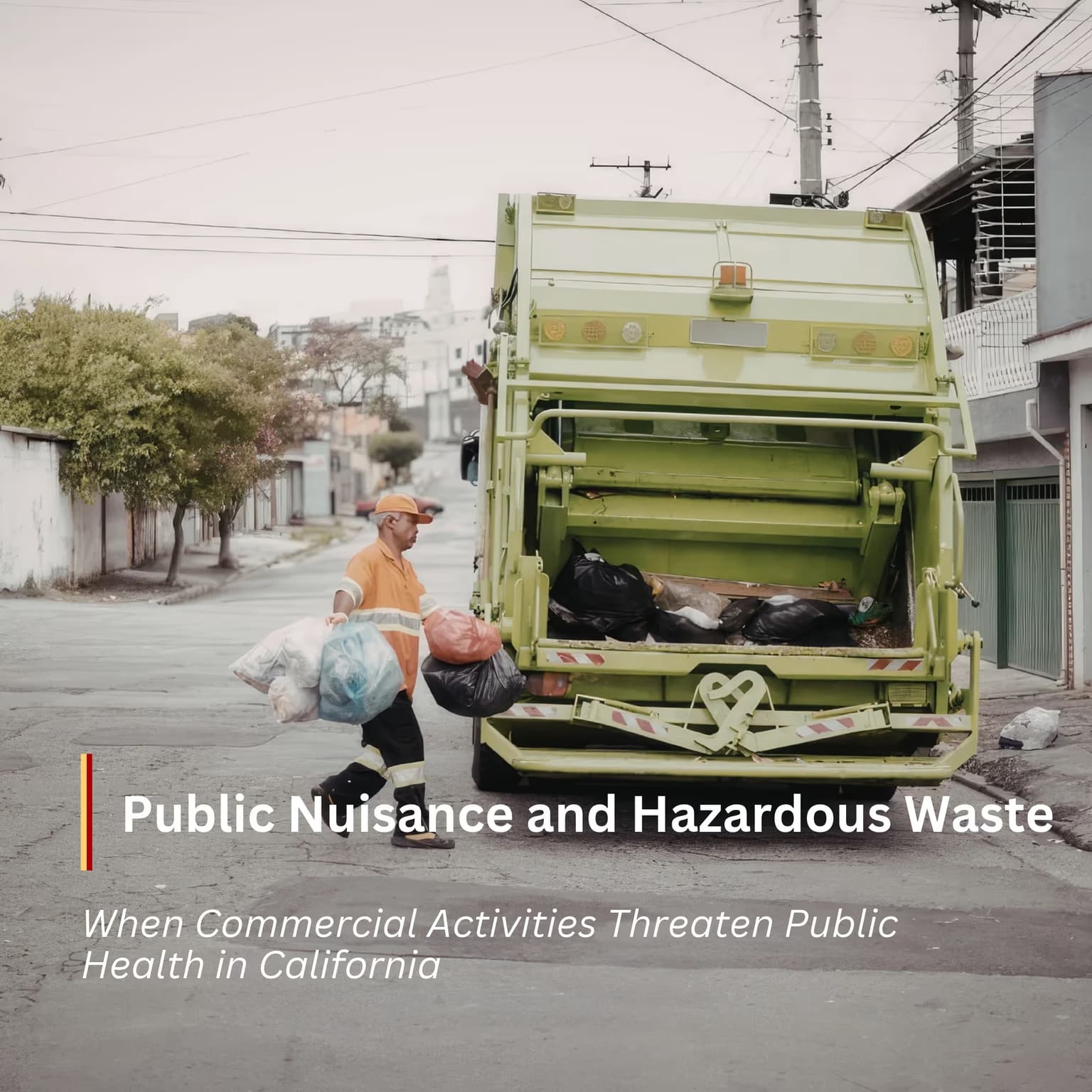
Public Nuisance and Hazardous Waste: When Commercial Activities Threaten Public Health in California
Public Nuisance and Hazardous Waste: An Overview
Hazardous waste in public places may cause serious health risks and concerns for exposed individuals. These nuisances are extremely dangerous, and taking the right steps is very important for maintaining your overall safety and well-being. California laws are set up to protect individuals from these types of dangers, and this article will help you become aware of these important systems. In addition, understanding the crucial steps to take, your legal rights, and responsibilities can help you keep yourself safe and free of harm moving forward.
Emergency Health Order In Los Angeles County: Chiquita Canyon Landfill
There has been a health order issued in Los Angeles County after an explosion at a landfill caused smoke to rise into the sky, leaving thousands concerned and fearful. Fire officials have advised that this smoke was the result of trash that was said to be decomposing, along with gases that were released.
The incident illustrates how commercial waste operations can raise concerns extending beyond the boundaries of a business property. When waste accumulates or escapes containment, surrounding communities may experience the following.
- Intense odors
- Pest activity
- Potential contamination
- Significant concerns about exposure to harmful substances
However, the existence of an unpleasant condition does not automatically establish that a business violated environmental laws. As a result, it is important to understand the complete facts of any case before determining potentially responsible parties.
What Is a Public Nuisance Under California Law?
California Civil Code Section 3479 defines a nuisance to include conditions that injure health, offend the senses, or interfere with the comfortable enjoyment of life or property. Under California Civil Code Section 3480, a public nuisance affects an entire community, neighborhood, or a considerable number of people. These nuisances may include, but are not limited to, the following.
- Persistent odors from waste processing or disposal facilities.
- Industrial emissions affecting nearby residential neighborhoods.
- Contaminated wastewater entering public drainage systems.
- Hazardous materials escaping from commercial properties.
- Excessive dust, smoke, or pollutants affecting public spaces.
Whether a specific activity creates a public nuisance depends on its nature, severity, duration, and effect on the surrounding community.
Can Residents Sue for a Public Nuisance?
California Civil Code Section 3493 generally allows a private individual to bring an action for a public nuisance when the nuisance causes that individual a special injury different in kind from the harm suffered by the general public.
Hazardous Waste and Commercial Environmental Responsibilities
Hazardous waste presents additional legal concerns because certain substances can threaten human health or the environment when improperly handled, stored, transported, or disposed of.
California's Hazardous Waste Control Law, beginning at Health and Safety Code Section 25100, establishes requirements governing hazardous waste management. Commercial facilities may be subject to obligations involving waste identification, labeling, storage, transportation, and disposal. In addition, it is important to understand that ordinary decomposing garbage is not automatically classified as legally regulated hazardous waste.
How Commercial Waste Conditions Can Affect Public Health
Poorly managed commercial waste may create several types of public health concerns.
- Air quality: Decomposing materials can produce strong odors and gases, while certain industrial activities may release regulated air contaminants.
- Physical hazards: Leaking containers, unstable waste piles, or uncontrolled spills may create risks for workers and nearby residents.
Individuals who may be affected by public waste should become aware of their symptoms and seek immediate medical care moving forward. It is important to do this in order to prevent the risk of further harm and danger.
Who May Be Responsible for a Commercial Public Nuisance?
Responsibility for a commercial nuisance depends on who created, maintained, controlled, or contributed to the harmful condition. Potentially involved parties may include, but are not limited to, the following individuals.
- Commercial operators
- Property owners
- Waste management contractors
- Transportation companies
- Other parties
California Civil Code Section 3491 recognizes remedies for public nuisance, including abatement and, in appropriate circumstances, civil actions. Government agencies may also investigate violations and pursue enforcement measures under environmental or public health laws.
Necessary Steps Individuals Should Take Moving Forward
Individuals who may be concerned about commercial waste or environmental hazards should consider taking practical steps to document the situation and notify appropriate authorities.
- Document the conditions. Record dates, locations, photographs, videos, and descriptions of odors, spills, or other visible hazards.
- Report potential violations. Contact the appropriate county environmental health department, local code enforcement agency, or environmental regulator.
- Preserve relevant records. Keep copies of complaints, inspection reports, communications, and property-related expenses.
- Seek medical attention when appropriate. Individuals experiencing symptoms following a suspected exposure should consult a healthcare professional.
The Importance of Speaking to A Legal Professional
California residents and businesses affected by potentially harmful commercial activities may have several legal questions. A qualified attorney may be able to review whether the circumstances support a public nuisance claim, private nuisance claim, negligence allegation, or another available legal remedy.
How KAASS LAW Can Help
The qualified personal injury attorneys at KAASS LAW are here to help individuals who may be affected by public nuisance and environmental hazards. These types of incidents may cause serious health risks and concerns for many individuals and their loved ones. Our legal team at KAASS LAW may review the specific facts of your case, preserve important pieces of evidence, and determine potentially responsible parties moving forward. Don’t wait! Contact KAASS LAW for a confidential consultation and to learn more about your possible legal options moving forward.

Driving at night can cause various dangers, leaving individuals in a state of fear and uncertainty. Accidents can happen due to bright headlights and can cause serious or sometimes life-threatening injuries. Understanding the steps to take when a vehicle collision occurs from a bright headlight is important for maintaining the safety of yourself and those around you on the road.
Why Are Bright Headlights Becoming a Road Safety Concern?
Modern vehicles usually use light-emitting diode (LED) headlights, which can provide improved illumination and energy efficiency. However, certain headlight designs may produce uncomfortable glare for other drivers and pedestrians. The following are various factors that can cause blinding headlight glare.
- Headlights with bright LED’s
- Modifications done to the headlights during the purchase of the vehicle
- Conditions of the road, especially during rain or excessive fog
How Can Bright Headlights Cause Car Accidents?
Bright headlights may contribute to vehicle collisions for many reasons. The glare from these headlights can temporarily interfere with a driver's ability to see clearly. This is especially concerning on two-lane highways, where vehicles travel in opposite directions without physical barriers.
Potential consequences may include reduced visibility, delayed reactions, difficulty recognizing pedestrians, and problems maintaining lane position.
For example, a driver traveling through a poorly illuminated intersection in Los Angeles may come across an approaching vehicle with improperly aimed headlights. If the glare causes the driver not to see clearly, they may struggle to recognize a pedestrian entering the crosswalk.
What Is the LIGHT Safety Act, H.R. 7772?
The Limiting Intense Glare for Highway and Two-lane Safety Act, commonly called the LIGHT Safety Act, was introduced in the U.S. House of Representatives on March 3, 2026, by Representative Marie Gluesenkamp Perez of Washington.
The proposed legislation directs the Secretary of Transportation, acting through the National Highway Traffic Safety Administration (NHTSA), to revise Federal Motor Vehicle Safety Standard No. 108. The bill would require:
- Establishing a maximum allowable brightness standard for low-beam vehicle headlights.
- Expressing the limit in lumens or another appropriate photometric measurement.
- Issuing a final rule within one year after the legislation becomes law.
How Could the LIGHT Safety Act Affect California Drivers?
If enacted, the LIGHT Safety Act could influence future vehicle headlight manufacturing standards nationwide, including vehicles sold in California. Manufacturers might need to adjust headlight designs to comply with new federal brightness requirements.
However, the legislation would not automatically establish liability whenever bright headlights contribute to an accident. This is important to understand in order to make sure you are keeping yourself and others safe on the road. In addition, existing California traffic laws and negligence principles would continue to play an important role in determining responsibility. If an individual is driving without exercising reasonable care, then they may be held responsible for causing a vehicle collision.
Separately, NHTSA announced in October 2026 that it was examining updates to federal vehicle lighting regulations, including headlight glare, LED technology, automatic high beams, and headlamp positioning.
What Does California Law Say About Bright Headlights?
California already regulates the use of vehicle headlights. Under California Vehicle Code Section 24409, drivers must adjust their headlights under certain circumstances:
- When approaching an oncoming vehicle within 500 feet, drivers must use lighting that does not shift the glaring rays into other individuals’ eyes.
- When following another vehicle within 300 feet, drivers must use the required lower-beam setting.
Who May Be Liable for a Car Accident Caused by Bright Headlights?
Determining potentially responsible parties is often very challenging, and usually depends on all the surrounding evidence of the accident itself.
Negligent Drivers
A driver may face liability if they improperly use high beams, fail to maintain their headlights, or operate their vehicle without reasonable care. Under California Civil Code Section 1714, individuals usually have a duty to exercise reasonable care to reduce the risk of causing injury to others.
Vehicle Manufacturers
Vehicle manufacturers may be held liable for a vehicle collision if they did not produce the correct headlight system. Inadequate headlights may cause serious injuries and leave individuals unsure of the next steps to take to recover.
The Importance of Seeking Legal Guidance and Support After a Headlight Vehicle Collision
If you believe excessive headlight glare contributed to a California car accident, taking appropriate steps may help preserve important evidence. After a collision involving a vehicle's headlights, you should consider the following.
- Seek medical attention as soon as it is possible and safe to do so.
- Documenting the scene of the accident
- Identifying nearby witnesses and collecting their contact information
- Preserving all available recordings
- Reporting the car accident as soon as possible
- Seeking legal guidance and support
How KAASS LAW Can Help
Accidents involving headlight glare can present complicated questions about visibility, driver conduct, vehicle equipment, and responsibility. KAASS LAW may be able to help individuals with personal injury matters in Los Angeles, Glendale, Pasadena, and surrounding Southern California communities.
Our attorneys can review the circumstances of a collision, examine available evidence, assess potential liability, and explain legal options under California law. Contact KAASS LAW today to learn more and discuss your potential options.